
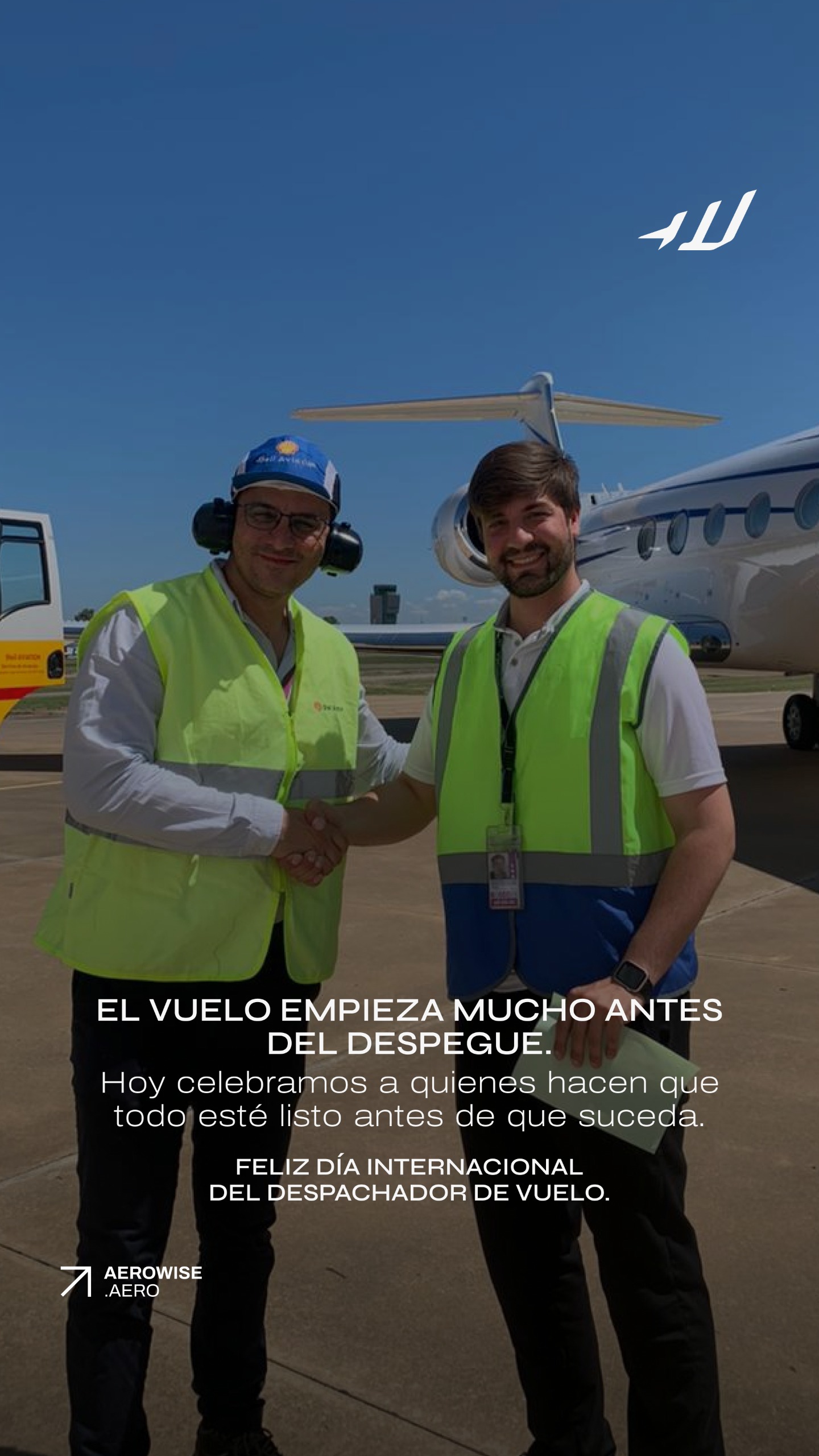
Every 21 April, South America marks Aircraft Dispatcher Day. The date goes back to a key moment: more than 30 years ago in Uruguay, representatives from several countries in the region approved the statutes of the Latin American Federation of Flight Operations Officers, granting it legal status and establishing this commemoration across the region.
Beyond its institutional origin, however, the day is an opportunity to recognise a central —and often unseen— role within the aviation system.
Deciding is operating
At first glance, as in any field, every decision has an impact and consequences. In aviation, that premise is not theoretical — it is operational. The dispatcher works precisely at that critical point where:
- Information turns into decisions.
- Decisions turn into operations.
- And operations turn into safety.
There is no flight without planning, and no planning without sound judgement.
Applied experience: the real differentiator.
In an increasingly automated environment, there is one thing that cannot be replaced:
Applied experience = know-how
A dispatcher does not simply process data:
- They interpret scenarios,
- Anticipate deviations,
- And manage uncertainty.
Especially in complex or degraded conditions, where manuals are no longer enough and what truly matters is analytical ability, situational awareness, and decision-making under pressure.
A key player in the safety system
The dispatcher’s role is structural.
They are an active element within the operational safety system. Their job is not simply to “get the flight out”, but to ensure it is safe, efficient, and operationally sustainable.
In practical terms, they are the ones who integrate variables such as:
- Weather,
- Performance,
- Alternate aerodromes,
- Fuel,
- Operational constraints.
Trust: the invisible asset
Being a dispatcher also involves something less tangible, yet equally critical:
Being reliable:
- Reliable for the crew,
- Reliable for the operation,
- Reliable for the customer.
Because in an environment where everything is interconnected, trust becomes:
- Operational continuity,
- Customer loyalty,
- Reputation.
- And that’s where a real differentiator emerges.
Providing solutions, always.
The DNA of dispatch is clear: to solve.
No matter the context — delays, restrictions, last-minute changes — the dispatcher is there to keep the operation moving and find a viable path forward.
A guarantee of safety.
Ultimately, the dispatcher represents a simple yet powerful idea: being a guarantee of safety. And in this industry, that is non-negotiable. It is — and will always remain — the number one priority.
Aerowise and the value of judgement
At Aerowise, where we aim to integrate operations through a 360° approach — operational, financial and administrative — the dispatcher’s role becomes even more relevant.
Judgement, experience, decision-making and technology all come together.
But ultimately, the dispatcher decides.
Today, we recognise those who, often behind the scenes, support every operation with knowledge, judgement and responsibility.
Because at the end of the day, one simple truth remains: there is no aircraft in the air without a decision behind it.
And many of those decisions… are made by a dispatcher.