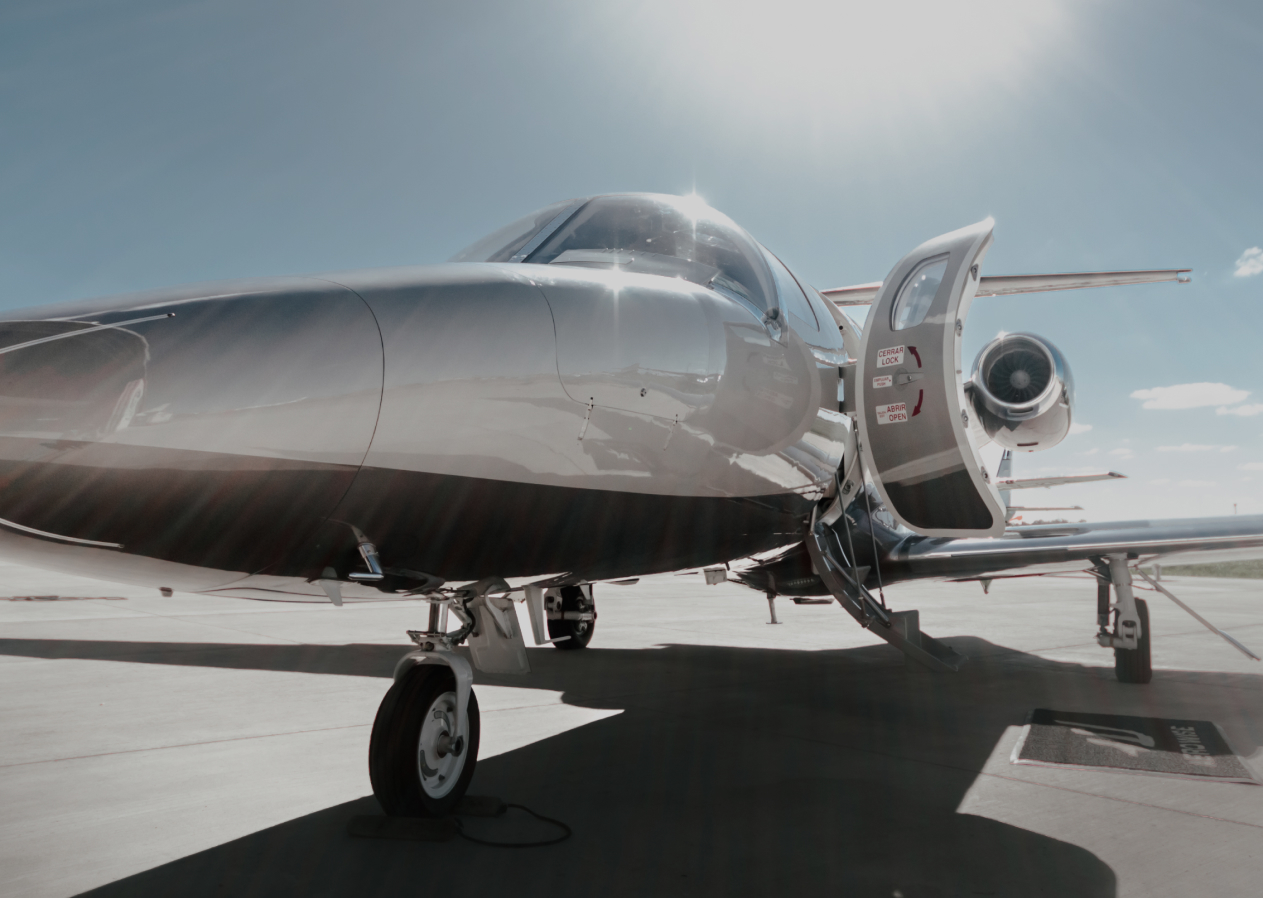
The real numbers, what’s actually included and why the price is only half the story.
If you’ve ever considered flying private from Buenos Aires to Punta del Este, São Paulo, Santiago, or Miami you’ve probably asked yourself the same question:
How much does it actually cost?
In Latin America, where infrastructure is inconsistent and your time is your most valuable asset, the answer goes far beyond a number. It’s about everything you get and everything you stop losing.
What does it cost per hour?
Departing from Buenos Aires, here’s what you can expect:
USD 4,000–6,000/hour for a light jet (Uruguay, Bariloche, Mendoza, Asunción) USD 7,000–10,000/hour for a midsize or super-midsize jet (Santiago, São Paulo, northern Brazil) USD 12,000+/hour for a long-range jet (Miami, New York, Europe)
These are real market rates. Not minimums designed to get your attention. Not maximums to scare you off.
What’s actually included and why it matters
This is where private aviation surprises most first-time flyers. A properly quoted charter includes far more than a seat on a plane. Here’s what you’re paying for:
The aircraft and crew. A fully certified flight crew captain and co-pilot trained, current, and dedicated entirely to your operation. No shared cockpit. No crew repositioned from another flight arriving tired. The pilots briefed on your specific route, weather, and requirements before you board.
Fuel. Calculated for your exact route, aircraft type, and conditions. No fuel surcharges added after the fact. No estimates that become surprises at checkout.
Ground handling. Reception at the FBO, aircraft parking, ramp coordination, and crew assistance at both origin and destination. The operation on the ground is as important as the operation in the air and it’s included.
Airport and navigation fees. Landing fees, overflight charges, and ATC fees for your route factored into the quote from the start, not itemized after you’ve agreed to fly.
Catering coordination. From a simple coffee setup to a full in-flight menu arranged in advance, tailored to your preferences and dietary requirements. No vending machines. No buying food at the gate.
Flexibility. Your departure time. Your passenger list. Your last-minute changes handled without penalty charges or call center queues. Private aviation is built around your schedule, not the other way around.
Privacy and security. No check-in lines. No shared waiting areas. You access the aircraft directly from the FBO, a private terminal separate from commercial operations. Your travel details, your companions, your conversations: none of it is public.
What can affect the price and how to read a quote correctly
Understanding these variables means you can evaluate any quote intelligently, not just compare numbers:
Positioning costs. If the aircraft needs to fly empty to reach your departure airport, that repositioning leg may be reflected in the quote. At Aerowise, this is always disclosed upfront never buried in a footnote.
Crew overnight stays. On multi-day trips or very early morning departures, crew accommodation may be an additional cost. Always itemized clearly so you know exactly what you’re approving.
Peak season surcharges. High-demand periods — summer in Punta del Este, end-of-year in Buenos Aires, major international events affect both availability and pricing. Planning ahead changes your options significantly.
Empty legs. When an aircraft needs to reposition without passengers, that flight is sometimes offered at a reduced rate. It’s one of the best-value options in private aviation — if your schedule has enough flexibility to use it. Ask your broker about empty legs on your route.
Aircraft age and category. A newer aircraft with a more recent avionics package costs more than an older one. A super-midsize with a full flat-bed costs more than a standard midsize. Knowing what you actually need — versus what sounds impressive — is part of flying wisely.
Three real-world routes and what they cost
Buenos Aires → Montevideo Aircraft: light jet. Flight time: approximately 45 minutes. Approximate cost: USD 6,000–9,000 for the full aircraft. Split between 4 passengers: USD 1,500–2,250 each.
Buenos Aires → Santiago Aircraft: midsize jet. Flight time: approximately 1h 45min. Approximate cost: USD 18,000–25,000 for the full aircraft. Split between 6 passengers: USD 3,000–4,200 each.
Buenos Aires → Miami Aircraft: long-range jet. Flight time: approximately 9–10 hours nonstop. Approximate cost: USD 80,000–120,000 for the full aircraft. Split between 8 passengers: USD 10,000–15,000 each.
These are reference ranges. The exact quote depends on aircraft availability, dates, and your specific requirements. At Aerowise, every quote is transparent from the first message — no surprises at the end.
The safety standard behind every flight
This is the question most people don’t ask — but should.
Not every private jet operator is the same. The industry has providers at every level of rigor — and the price on a quote doesn’t always tell you which one you’re getting.
Every aircraft Aerowise operates with is certified under ANAC or its international equivalent. Every operator in our network carries current air operator certificates, full third-party liability insurance, and a crew with verified flight hours and documented recurrent training. We audit the operators we work with — not just the first time, but continuously.
We don’t quote from the cheapest available option. We quote from the most reliable one for your specific operation. In private aviation, the difference between a good broker and a bad one isn’t visible on the quote. It’s visible when something goes wrong — and with the right partner, it rarely does.
What this means in practice: when you fly with Aerowise, you know the operator has been vetted, the aircraft is airworthy, the crew is qualified, and someone on our team is monitoring the operation from departure to arrival.
But what does it cost NOT to fly private?
Most executives and entrepreneurs in Latin America don’t lack money. They lack time — and tolerance for inefficiency.
A commercial flight Buenos Aires → São Paulo costs you: 2–3 hours early arrival. Security. Immigration. A connection, usually. Ground transfer from a distant airport. Total time lost: 6 to 10 hours per trip.
You arrive tired. You start late. You perform below your level.
The same route by private jet: door to FBO in 30 minutes, board immediately, 2.5 hours productive in the air, land at a closer airport, ground transfer direct to your destination. Total time: under 4 hours. Working — or resting — the entire way.
Buenos Aires → São Paulo: the real comparison
| Commercial | Private | |
| Total door-to-door time | 6–8 hours | 2.5–3 hours |
| Airport experience | Lines, delays, chaos | VIP terminal, no wait |
| Productivity on board | Minimal | 2 focused hours |
| Stress | High | None |
| Flexibility | None | Total |
The math: a commercial ticket might cost USD 500. But if your time is worth USD 1,000 per hour and you lose 6 hours — that “cheap” ticket cost you USD 6,500 in opportunity. And gave you nothing in return.
A USD 10,000 private flight split between 4 passengers at USD 2,500 each? You get back time, focus, privacy, and control. That’s not an expense. That’s a decision.
And the freedom you can’t price?
Being home in time for dinner. Closing a deal at 41,000 feet. Making one more client visit the same day. Taking your family on a last-minute flight without checking airline schedules three weeks out.
This isn’t about status. Private aviation exists for one reason: freedom for those who value time over savings.
Want a pricing reference for your specific route? → Chat with us on WhatsApp